


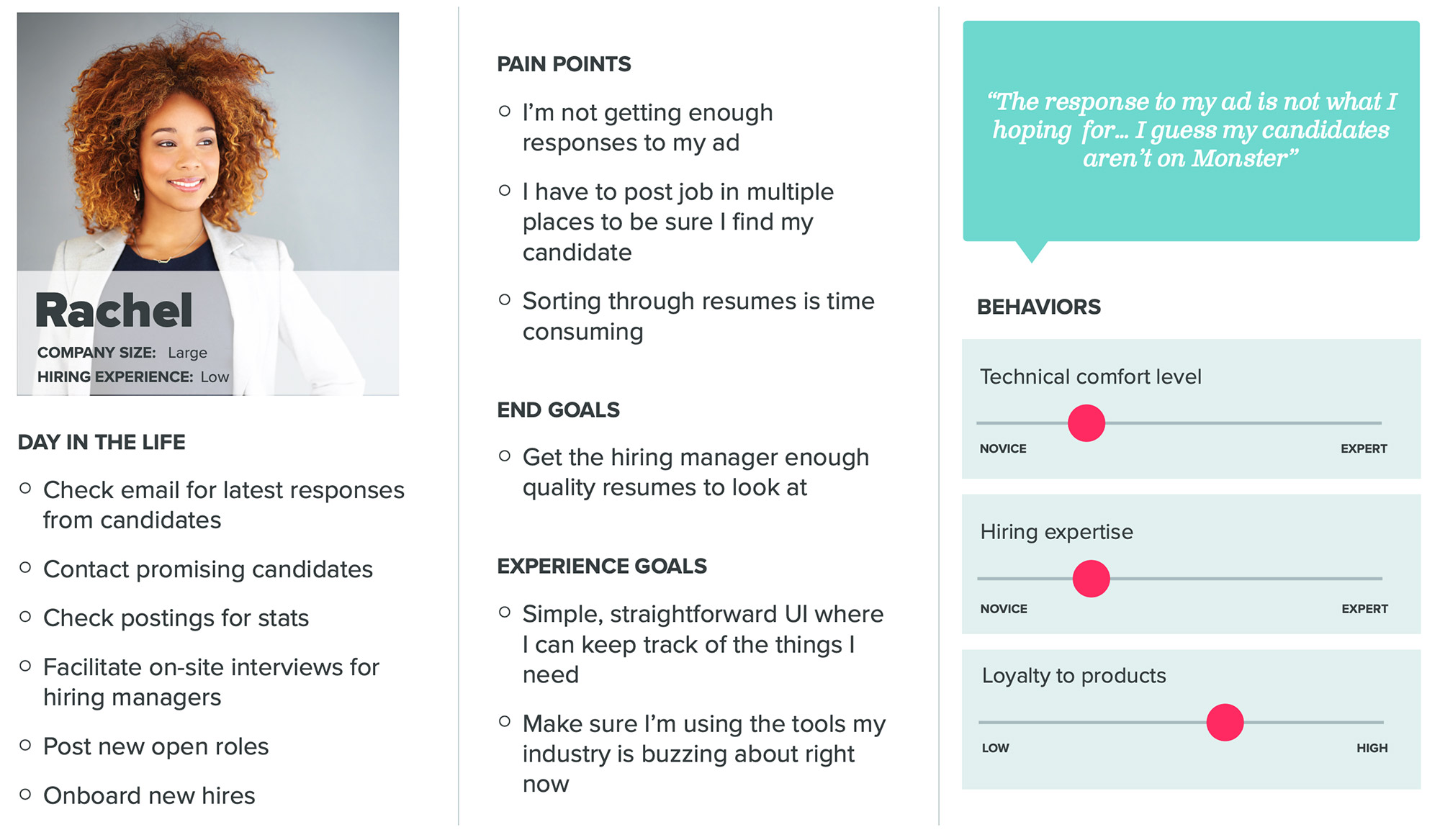
From Guesswork to Empathy: Six User Personas for Success
April 23, 2026When Monster set out to redesign and strengthen its B2B employer product, Recruiter Office, the team faced a familiar challenge: the people who use a hiring platform don’t all think alike, work alike, or worry about the same things. A solo business owner posting their first job has almost nothing in common with a seasoned corporate recruiter managing a pipeline of 200 applicants. Yet both are sitting in the same product.
To close that gap, our UX research team developed six distinct user personas grounded in behavioral research, stakeholder interviews, and journey-mapping workshops. This post walks through how we built them, what each persona revealed, and why the exercise fundamentally changed how we prioritize product decisions for Recruiter Office.
Why Personas? Why Now?
Recruiter Office is Monster’s end-to-end hiring suite for employers — covering everything from writing a job post to extending an offer. Its users span an enormous range of company sizes, hiring sophistication levels, and emotional relationships with the product.
Without a shared language for who we were designing for, our teams kept designing for a theoretical “average user” that didn’t actually exist. Feature decisions got made in a vacuum. Support tickets hinted at real pain but lacked enough context to act on. And sales was pitching the product differently to every segment.
The answer wasn’t more data — it was organized data. Personas gave us a framework for turning qualitative and quantitative research into actionable, human-centered stories. And critically, they gave every team — product, design, engineering, marketing, and sales — a common vocabulary.
The Methodology: Building the Buyers Experience Map
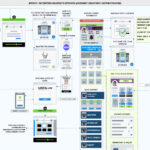
Before we could write a single persona, we needed to understand the full arc of an employer’s journey with Monster. We ran discovery workshops, conducted contextual interviews with over 40 hiring stakeholders, and synthesized findings into a Monster Buyers Experience Map — a comprehensive artifact that maps the employer’s path from “We have no current job openings” all the way through Post-Hire success evaluation.
The map is organized around distinct phases:
- We have no current job openings — passive awareness and competitive scanning
- We have a job opening — requirements gathering, role scoping, budget setting
- Get the word out we’re looking — sourcing strategy, multi-channel posting
- Purchase from Monster — product evaluation, cart, and confirmation
- Post a Job — writing, previewing, and publishing the listing
- Receive and Sort Applications — screening, filtering, and candidate management
- Interviewing — scheduling, tracking, and coordinating candidates
- Make an Offer — negotiation, hiring manager alignment, offer validation
- Post-Hire / Decide Success — onboarding, retention, and evaluating Monster’s ROI
For each phase, we documented six dimensions:
- Phase Goal — what the user is trying to accomplish
- Phase Actions — the specific steps they take
- Monster Opportunities — where the product can add value
- Feelings — the emotional state (ranging from anxious 😰 to hopeful 😊 to stressed out 😤)
- Obstacles & Frustrations — the friction points that stall progress
- Outside Influences — who else shapes their decisions
- Monster’s User Phase Goal — what success looks like from our side
This framework became the backbone for each of the six personas.
1. The HR Generalist
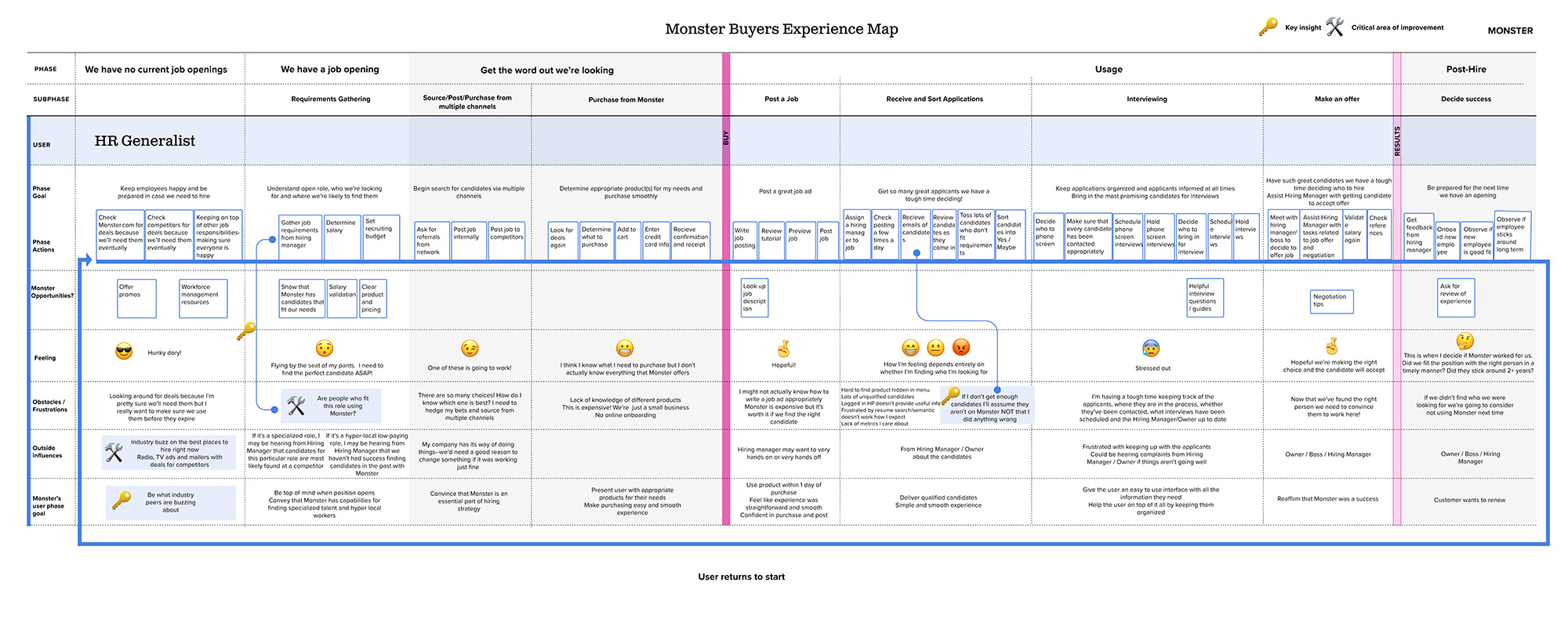
“I need to keep everyone happy and be prepared in case we need to hire.”
The HR Generalist is the backbone of mid-market hiring. She wears many hats — employee relations, benefits, compliance, and recruiting — and hiring is just one of them. She’s not a power user, but she’s not a novice either. She checks Monster occasionally even when there’s no open role, staying alert to what competitors are offering and whether there’s talent worth flagging for the future.
When a role does open, she moves fast to gather requirements from the hiring manager, research salary benchmarks, and set a recruiting budget. She’s often flying by the seat of her pants — not because she’s disorganized, but because hiring sits on top of an already full workload.
Key insight: She doesn’t need more features. She needs clarity, speed, and confidence that she’s not missing something. During the application review phase, she can feel genuinely overwhelmed — “How am I feeling depends entirely on whether we’re finding who we’re looking for.” Monster Opportunities here include guided workflows, candidate ranking tools, and proactive candidate matching. Her critical area of improvement is the interview coordination phase, where tracking status across candidates and interviewers becomes a logistical headache.
Emotional arc: Starts curious → becomes hopeful when sourcing begins → hits stress during application overload → relieved when a strong candidate emerges.
2. Lower-Level HR
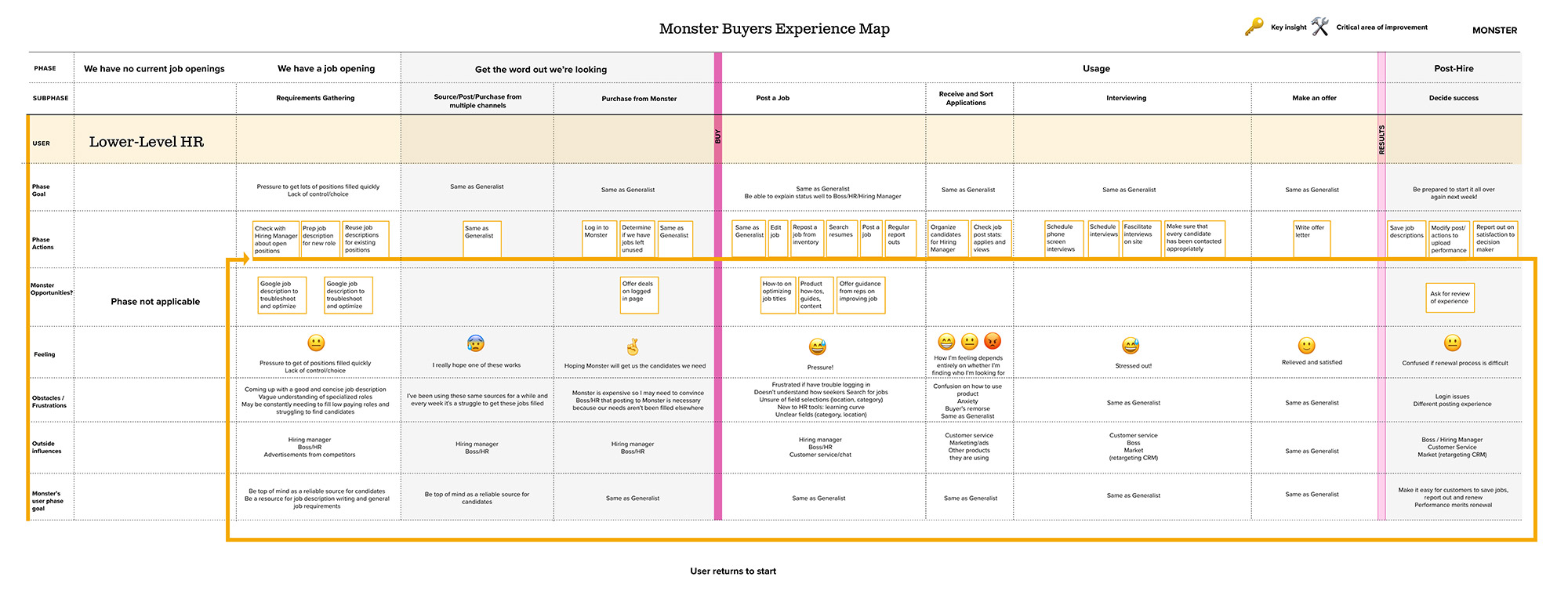
“I was told to post this job. I’m not sure exactly what I’m doing.”
The Lower-Level HR persona is often a coordinator, administrator, or junior HR associate who has been handed a task — “post this job on Monster” — without a lot of context or training. She’s brand new to Recruiter Office, or returns to it infrequently enough that it always feels new. She’s not confident, and she doesn’t want to make a mistake.
This persona is disproportionately affected by usability issues that experienced users have learned to work around. Unclear navigation, ambiguous field labels, and lack of in-product guidance hit her hardest. She’s also susceptible to abandonment — if something feels too complicated or too risky, she’ll stop and ask someone else rather than proceed.
Key insight: Onboarding and in-context help are critical for this persona. She represents a large share of Monster’s day-to-day users, especially in SMB accounts. Any friction in the job posting flow — unclear product options, confusing pricing, lack of preview capability — translates directly into drop-off or support volume.
Monster Opportunity: Step-by-step guided flows, tooltips, and progress indicators. The purchase confirmation phase should feel reassuring, not transactional. Monster’s goal for her is simple: make purchasing easy and smooth, and build confidence at post-and-confirm.
Emotional arc: Tentative → briefly relieved after posting → anxious while waiting for results.
3. The Owner
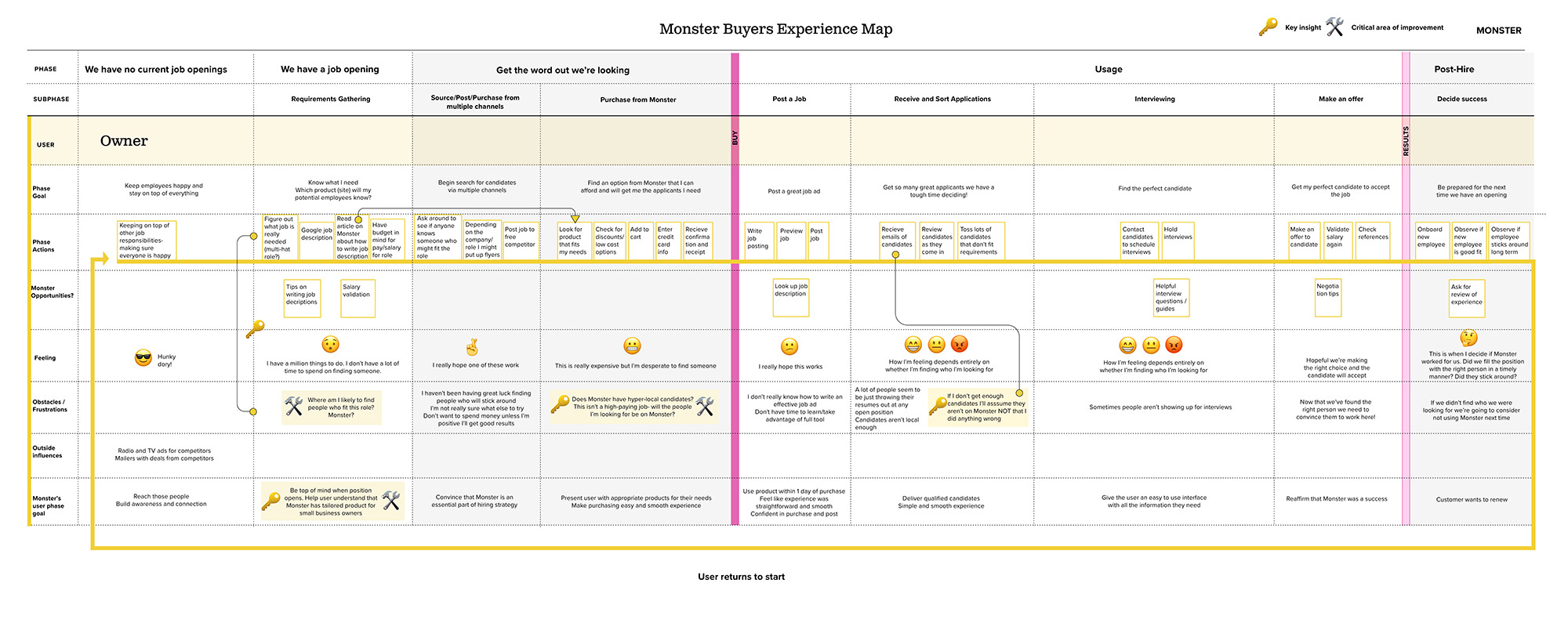
“I just need the right person. I don’t have time to learn a new platform.”
The Owner is a small business founder or operator — often a first-time hirer on Monster — who is personally invested in the outcome of every hire. This isn’t an abstract HR function; a bad hire costs money she doesn’t have. She’s decisive when she knows what she wants, but deeply skeptical of anything that feels like a waste of time.
She doesn’t browse Monster for fun. She shows up with a specific need, wants to act quickly, and will abandon the experience if it feels complicated or expensive without a clear payoff. She’s influenced heavily by industry peers, business owners in her network, and what she sees on review platforms like G2 or Capterra.
Key insight: The Owner needs Monster to prove its value fast. During the sourcing and purchasing phase, she’s asking herself: “Is this worth it? Will I actually get good candidates from this?” Social proof, product transparency, and outcome data are her persuasion levers. Her biggest obstacle is distrust of the platform if she’s had a past bad experience — or heard one from a peer.
Monster Opportunity: Clear ROI framing, simplified product tiers, and immediate candidate activity post-posting. In the post-hire phase, her question isn’t just “did this hire work out?” — it’s “did Monster work out? Would I use it again, or tell a friend to?”
Emotional arc: Skeptical at entry → momentarily optimistic post-purchase → impatient while waiting → satisfied or disappointed based on candidate quality.
4. The Recruiter
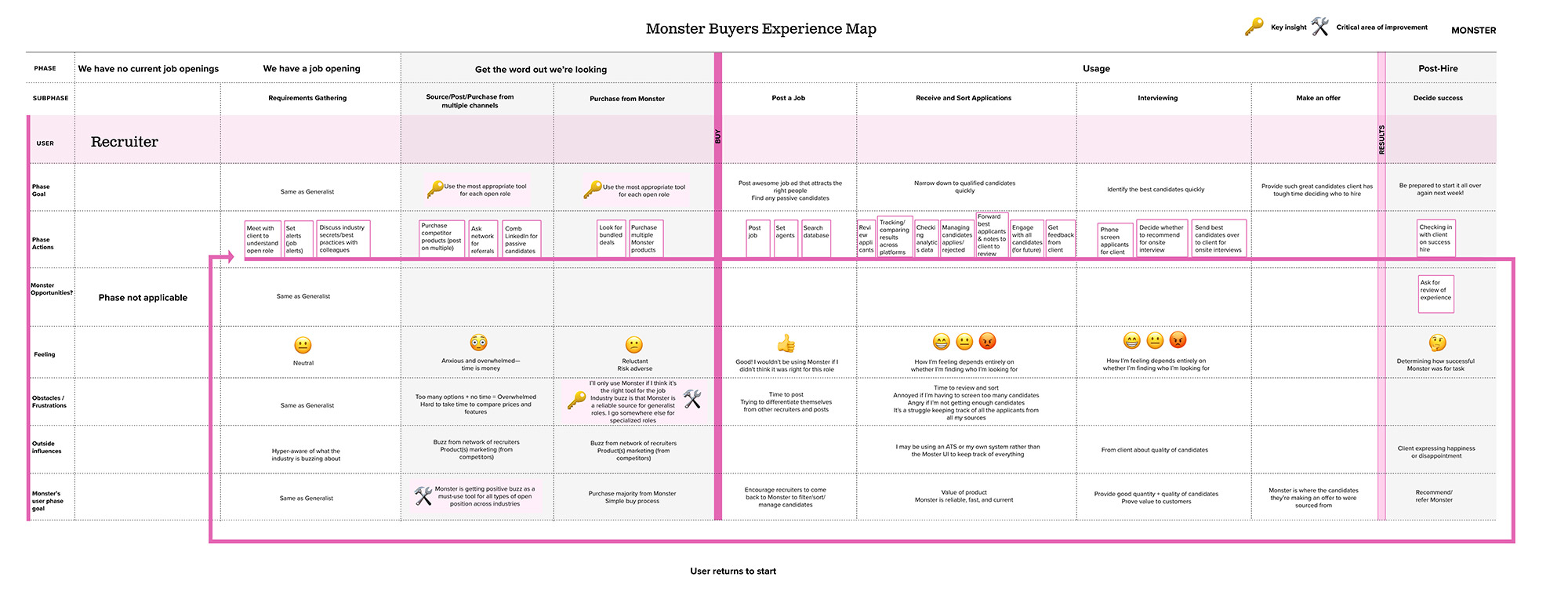
“I live in this tool. I need it to keep up with me.”
The Recruiter is a professional — in-house or agency — who spends their entire day in Recruiter Office. They’re posting multiple jobs, managing active pipelines across dozens of candidates, and context-switching between roles constantly. They’ve mastered the basics and now notice every inefficiency.
Unlike other personas, the Recruiter doesn’t need to be convinced Monster can work. They know it can. What frustrates them is when it doesn’t work fast enough — when candidate tracking is clunky, when interview scheduling requires leaving the platform, when bulk actions aren’t available, or when reporting doesn’t give them what they need to show their manager results.
Key insight: The Recruiter is a power user and a product advocate — but only if the product respects their expertise. The application review and interviewing phases are where Recruiter Office needs to earn their loyalty. They want candidate data organized intelligently, status visible at a glance, and hiring manager communication streamlined.
Monster Opportunity: Advanced filtering, bulk candidate actions, integration with ATS and calendar tools, and reporting dashboards. The Recruiter is also an internal champion for Monster adoption — if she loves it, she’ll drive renewal.
Emotional arc: Confident and in-flow when the product works → frustrated when it breaks their rhythm → vocal (internally or externally) about pain points.
5. The Skeptic
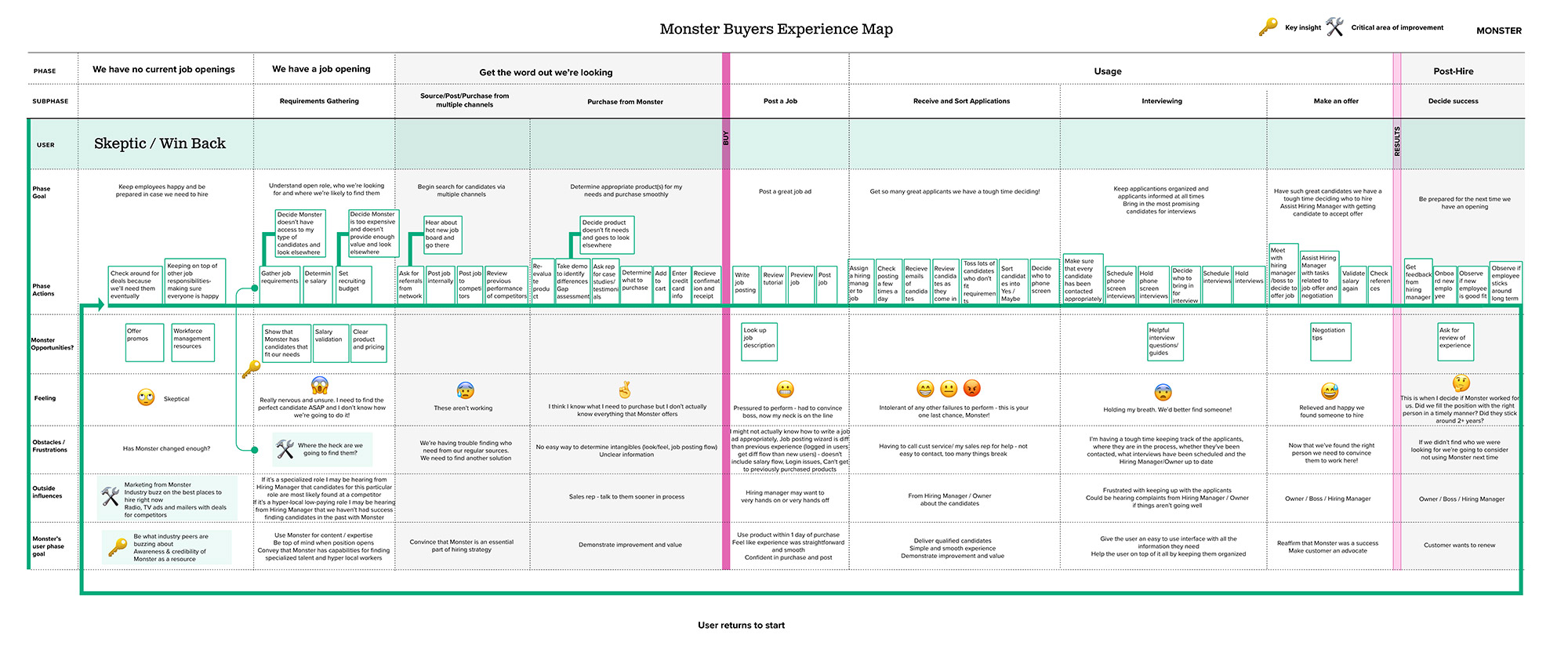
“Prove it. I’ve been burned before.”
The Skeptic is the most challenging — and most important — persona. She may be a hiring manager, a COO, or a department head who controls the budget. She’s seen recruiting tools come and go, has paid for platforms that underdelivered, and brings a healthy dose of cynicism to every vendor relationship including Monster.
She’s not the day-to-day user of Recruiter Office, but she influences or approves the purchasing decision. She evaluates Monster against alternatives on ROI, ease of justification to leadership, and whether the results are trackable. If the data doesn’t tell a clear story, she won’t renew — and she’ll tell others why.
Key insight: The Skeptic doesn’t just need a good product experience; she needs a convincing narrative. During the post-hire and renewal phase, Monster’s ability to surface outcome data — candidates hired, time-to-fill, quality of pipeline — directly determines whether she stays. Her obstacle is that she may not be logging in herself, which means any ROI story has to be delivered to her proactively, not discovered organically.
Monster Opportunity: Executive reporting, outcome summaries, renewal-time ROI recaps. The sales and customer success teams need persona-specific messaging for this user — one that speaks to accountability and business outcomes, not features.
Emotional arc: Doubtful at purchase → watchful during usage → demanding at renewal → loyal only if results are clear and defensible.
6. The Hiring Manager
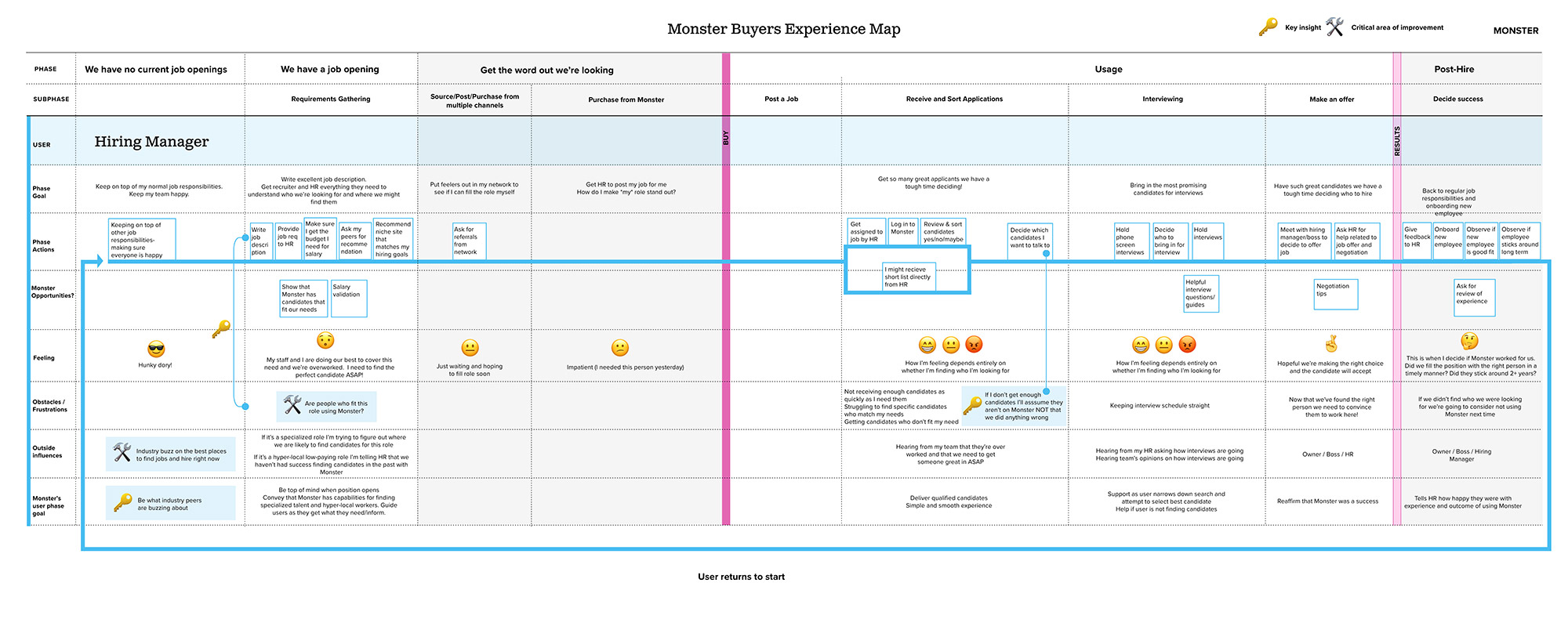
“Just send me the good ones. I don’t have bandwidth for the rest.”
The Hiring Manager isn’t an HR professional — they’re a department head, team lead, or functional manager who has a role to fill on their own team. They care deeply about the outcome of the hire because they’ll be working alongside that person every day. But they have no patience — or time — for the mechanics of recruiting.
They’re a secondary user of Recruiter Office in the sense that HR or a Recruiter typically does the sourcing and initial screening. But the Hiring Manager becomes essential — and often a bottleneck — during the interviewing and offer phases. They expect a curated shortlist to appear in their inbox, not a raw feed of 80 applicants. When the tool requires them to do more than review and respond, they disengage.
Key insight: The Hiring Manager’s relationship with Recruiter Office is mediated almost entirely by what HR or the Recruiter puts in front of them. If that handoff is smooth — concise candidate summaries, easy interview feedback submission, clear next-step prompts — they stay engaged. If it’s clunky — forwarded email chains, spreadsheet attachments, unclear status — they check out and the process stalls. Their biggest obstacle is feeling like the platform was built for HR, not for them.
Monster Opportunity: Lightweight collaboration features designed for non-HR users — a simplified candidate review view, single-click interview feedback, and mobile-friendly notifications. The Hiring Manager doesn’t need to live in Recruiter Office, but they do need a frictionless on-ramp into the moments that require their input. Monster’s goal is to make their involvement feel effortless, not like a second job.
Emotional arc: Initially indifferent → engaged when candidate quality is high → frustrated by process friction during interviews → relieved and invested once the right person is identified → the most vocal advocate or critic when the hire succeeds or fails.
What the Personas Changed
Building these six personas wasn’t an academic exercise. The impact showed up almost immediately in how we made decisions.
Product prioritization shifted. When a feature request came in, we could now ask: which persona does this serve? That gave us a principled way to compare, say, an advanced filter for the Recruiter against a simplified onboarding flow for Lower-Level HR — two genuinely important improvements that had previously competed on gut instinct alone.
Marketing found sharper messaging. Each persona has different emotional triggers, different outside influencers, and different definitions of success. The Owner needs reassurance about ROI. The Recruiter needs to feel understood as a professional. The Skeptic needs evidence, not enthusiasm.
Sales conversations improved. Armed with persona profiles, account executives could qualify leads faster and tailor demos to the user’s actual workflow rather than giving a generic product tour.
Design reviews got more grounded. Instead of debating whether a UI change “felt right,” teams could anchor feedback to a specific persona’s mental model and phase goal. “Does this work for Lower-Level HR who doesn’t know what a ‘sponsored slot’ means?” is a much more productive question than “Is this too complicated?”
Conclusion: Empathy at Scale
User personas are sometimes dismissed as fluffy UX artifacts that live in a Figma file and get forgotten. That’s a failure of execution, not concept. When personas are built from real research, mapped to real journey stages, and actively used to drive decisions, they become one of the most cost-effective investments a product organization can make.
For Recruiter Office, these six personas — the HR Generalist, the Lower-Level HR associate, the Owner, the Recruiter, and the Skeptic — represent the real humans behind every session, every posting, and every renewal decision. They remind us that our job isn’t to build a hiring platform. It’s to help specific people, with specific pressures and specific fears, find the right person for the job.
When we design with that in mind, the product gets better. And when the product gets better, employers come back.