


Seven personas, one membership: mapping the USTA Coaching experience.
April 30, 2026The USTA had spent years investing in coaching education, certification, and Safe Play requirements, but those investments lived in different systems with different logics. A coach who wanted to upgrade her credential, register a new junior team, and finish her continuing-education coursework could find herself in three different products in a single afternoon. The membership experience needed to be unified into a single arc — one that an aspiring coach could enter and a master coach could grow inside, without either feeling crowded out by the other.
Seven coaches, not one
Through field interviews, surveys, and section-level workshops with USTA staff, we built out seven personas covering the realistic shape of the coaching community: the parent-volunteer just beginning to teach the game, the developmental coach working with juniors, the club professional running adult programs, the high-performance specialist, the master coach mentoring others, the adaptive-tennis coach, and the cross-training professional moving in from another sport. Each persona arrived at USTA Coaching with a different motivation, a different willingness to pay, and a different relationship to the certification ladder.
A platform that flattens its members into a single user is a platform most of its members will eventually leave.
Three phases, mapped per persona
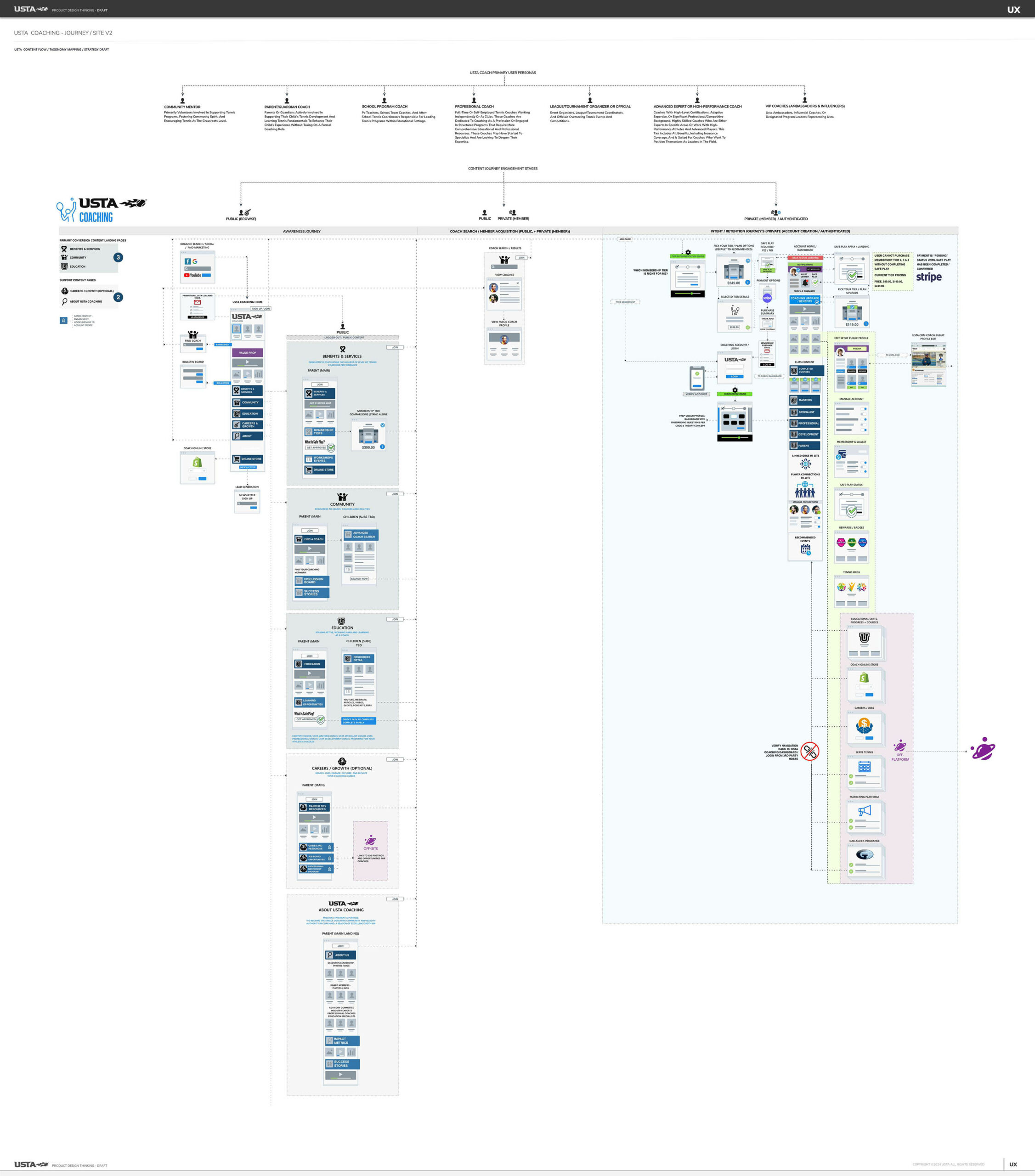
We organized the journey into three phases — Awareness, Acquisition, and Retention — and ran each persona through all three. Awareness covered everything that happened before a coach was logged in: marketing surfaces, peer referrals, USTA section communications, and the public content that helps a coach decide whether to join at all. Acquisition covered the membership flow itself: tier selection, Safe Play validation, payment, and account creation. Retention covered the authenticated experience — the dashboard, the continuing education library, profile management, and the renewal moment.
Acquisition: the place the system most needed to bend
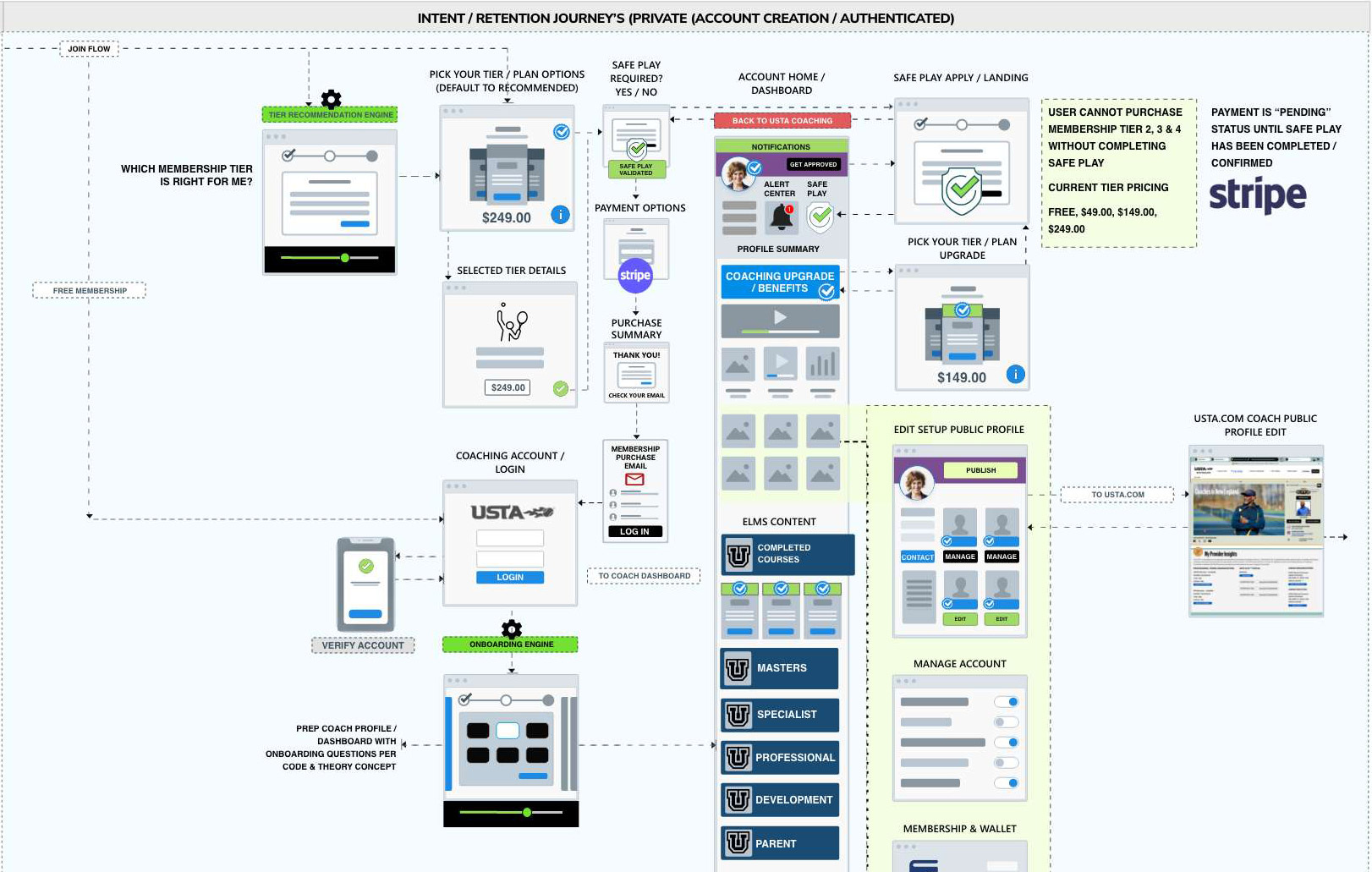
The acquisition phase was where the personas diverged most sharply, and where the journey map did its hardest work. We built a tier-recommendation engine into the front of the flow, so that a coach who wasn’t sure which membership fit her career could answer a few short questions and land on a default tier — while still being free to override the recommendation. The four available tiers (free and the paid options at $49, $149, and $249) each unlock different layers of benefit, and the journey makes those differences legible at the moment of choice rather than burying them in a comparison table after the fact.
Safe Play sits at the heart of the acquisition flow. The USTA requires Safe Play certification before a coach can purchase Tier 2, 3, or 4 memberships, and historically that requirement was a common drop-off point. We mapped Safe Play as a first-class step in the journey rather than a side task: payment is held in a “pending” state through Stripe until Safe Play has been completed and confirmed, with the dashboard providing an explicit “Get Approved” path when needed. The result is a flow that surfaces the requirement honestly without losing the committed coach in the meantime.
Mapping decision: rather than gate the entire purchase behind Safe Play, we designed payment to begin and resolve asynchronously, with a clearly named pending state. That single change converted Safe Play from a brick wall into a checklist item.
Retention: a dashboard that knows which coach you are
Once a coach is inside the system, the journey forks meaningfully. The authenticated dashboard pulls in the coach’s ELMS content — completed courses, plus the continuing-education ladders for Masters, Specialist, Professional, Development, and Parent tracks — so that the next-best step is always visible. A profile-and-public-page module lets coaches present themselves to USTA.com’s public coach directory, with edit, contact, and management surfaces that mirror how the coach actually thinks about their professional brand. Retention, we argued, is what happens when the system reflects the coach back to herself in a way she recognizes.
The journey as artifact
The journey map itself was delivered as a navigable artifact: a single, large-format diagram tracing each persona through the three phases, with annotated swim lanes for marketing inputs, product surfaces, third-party systems (Stripe, Safe Play, ELMS), and emotional state. It served two audiences. For USTA leadership, it became a way to see the membership experience whole and to prioritize where to invest. For the product and engineering teams, it became a working document — the spec from which acquisition flows, dashboard wireframes, and onboarding logic were drawn.
Outcome
The journey map is now the canonical reference for product decisions across USTA Coaching. The acquisition flow it informed reduced friction in the Safe Play step measurably, the tier recommendation engine routes a meaningful share of new members into the appropriate paid tier on the first try, and the retention dashboard’s persona-aware structure has given the organization a clearer view of how its coaches actually progress. More than any single screen, the lasting deliverable is a shared mental model: when the team talks about “the coach,” they now know which one of the seven they mean.