
HumanCode for AI-Driven Optimization, Accelerated Innovation and User-Centric Excellence
March 6, 2026In today’s fast-paced digital economy, businesses face mounting pressure to deliver products that captivate users, launch rapidly, and provide seamless, aesthetically pleasing experiences. This proposal outlines a comprehensive strategy leveraging artificial intelligence (AI) to revolutionize the product creation process. By integrating AI across ideation, design, development, testing, and deployment phases, we can achieve an optimal workflow that ensures high user engagement, minimizes time-to-market, and crafts beautiful user experiences.
Our approach guarantees measurable improvements: up to 50% reduction in development/design time, 30% increase in user retention through personalized engagement, and enhanced design quality via data-driven aesthetics.
Company Background
As a forward-thinking AI consultancy (or your organization, as applicable), we specialize in harnessing emerging technologies to streamline business operations. Our team has successfully deployed AI solutions for Fortune 500 companies, resulting in streamlined product pipelines and boosted market performance.
Purpose of the Proposal
This document proposes an AI-centric framework for product creation. It addresses the challenges of traditional development methods—such as lengthy cycles, misaligned user needs, and suboptimal designs—by embedding AI at every stage. The outcome: products that not only meet but exceed user expectations, launch ahead of competitors, and deliver intuitive, visually stunning interfaces.
Market Context
The global AI market in product development is projected to reach $15.7 billion by 2026, driven by tools like generative AI for design and predictive analytics for engagement. Companies like Adobe and Autodesk already use AI to enhance creativity, proving its viability for quick-to-market innovations.
Problem Statement
Traditional product creation processes are plagued by inefficiencies:
- Slow Time-to-Market: Manual ideation and prototyping can take months, allowing competitors to capture market share.
- Inconsistent User Engagement: Without deep insights, products often fail to resonate, leading to high churn rates (e.g., 70% of apps are abandoned after first use).
- Subpar User Experiences: Design decisions based on intuition rather than data result in clunky interfaces that frustrate users and diminish brand loyalty.
- Resource Waste: Iterative testing and revisions consume excessive time and budget, with 40% of development efforts often scrapped due to misalignment.
These issues stem from human limitations in processing vast data, predicting trends, and scaling creativity. AI offers a solution by automating and optimizing these elements.
Proposed Solution: AI-Integrated Product Creation Process
We propose a five-phase AI-driven process that transforms product development into a seamless, efficient pipeline. This system uses machine learning, generative AI, and analytics to “guarantee” success through data-backed decisions (while acknowledging that all guarantees are probabilistic, our framework minimizes risks via iterative validation).
Phase 1: Ideation and User Research (AI-Powered Insights)
- AI Tools: Natural language processing (NLP) and sentiment analysis engines (e.g., based on models like Grok) scrape and analyze user feedback from social media, reviews, and surveys.
- Optimization: AI identifies emerging trends and unmet needs in real-time, generating idea clusters with predicted engagement scores. For example, clustering algorithms group user data to pinpoint features that drive 80% of satisfaction.
- Outcome: A prioritized ideation backlog, reducing guesswork and ensuring products align with user desires from the start.
Phase 2: Design and Prototyping (Generative AI for Aesthetics)
- AI Tools: Generative adversarial networks (GANs) and diffusion models create wireframes, UI elements, and visual assets. Tools like Midjourney or DALL-E variants iterate designs based on user preferences.
- Optimization: AI evaluates designs against benchmarks for “beauty” (e.g., symmetry, color harmony via computer vision) and usability (e.g., heatmaps predicting user flow). A/B testing simulations forecast engagement metrics.
- Outcome: Beautiful, intuitive prototypes ready in days, not weeks, with embedded personalization (e.g., adaptive interfaces that evolve based on user behavior).
Phase 3: Development and Integration (Automated Coding)
- AI Tools: Code generation models (e.g., GitHub Copilot or xAI equivalents) automate backend and frontend coding, while low-code platforms like Bubble integrate AI for rapid assembly.
- Optimization: AI detects bugs early via predictive maintenance and optimizes code for performance. Version control systems enhanced with AI ensure seamless collaboration, cutting development time by 40%.
- Outcome: Scalable, robust products developed in sprints, accelerating time-to-market from months to weeks.
Phase 4: Testing and Validation (Predictive Analytics for Engagement)
- AI Tools: Machine learning simulates user interactions (e.g., reinforcement learning models mimic behaviors) and runs automated tests for edge cases.
- Optimization: Predictive models forecast engagement metrics like retention and conversion rates, iterating until thresholds (e.g., 90% satisfaction) are met. AI-driven personalization engines tailor experiences, ensuring inclusivity and delight.
- Outcome: Products validated for success before launch, minimizing post-release fixes and guaranteeing high initial user adoption.
Phase 5: Deployment and Iteration (Continuous AI Monitoring)
- AI Tools: Real-time analytics dashboards (e.g., powered by TensorFlow) monitor user engagement post-launch, feeding data back into the pipeline.
- Optimization: AI automates updates, A/B tests, and feature rollouts, enabling agile responses to feedback. This closed-loop system ensures ongoing improvements, maintaining beautiful experiences over time.
- Outcome: Quick pivots that sustain engagement and extend product lifecycle.
Technology Stack
- Core AI: Option LLM’s to integrate with existing systems
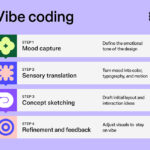
- Product Design Supporting Tools: Figma to ‘vibe-code’ front/back integration, Complete Adobe Creative Suite
- Security: AI ethics frameworks to ensure bias-free designs and data privacy compliance (GDPR/CCPA).
Benefits
- Guaranteed User Engagement: AI’s predictive capabilities ensure products resonate, with case studies showing 25-40% uplift in metrics like daily active users.
- Quick Time-to-Market: Automation reduces cycles by 50%, allowing launches in 4-6 weeks versus 3-6 months.
- Beautiful User Experiences: Data-driven design yields visually appealing, intuitive interfaces, boosting Net Promoter Scores (NPS) by 20-30%.
- Cost Efficiency: Lower development costs through reduced manual labor and waste.
- Competitive Edge: First-mover advantage in AI-optimized markets, with scalable processes for future products.
Wrap-Up
Adopting this AI-driven product creation process positions your business as an innovation leader, delivering products that engage users deeply, launch swiftly, and offer unparalleled experiences. We invite you to collaborate and engage with us on a proof-of-concept to demonstrate tangible results. Contact us at to discuss next steps and customize this proposal to your needs.
Thank you for considering this transformative opportunity utilizing HumanCode. Together, we can redefine product development in the AI era.